
Project Cargo
Complex cargo calls for technical planning.
For heavy, oversized and specialised cargo, the route, lifting interface and risk controls should be considered before the movement begins.
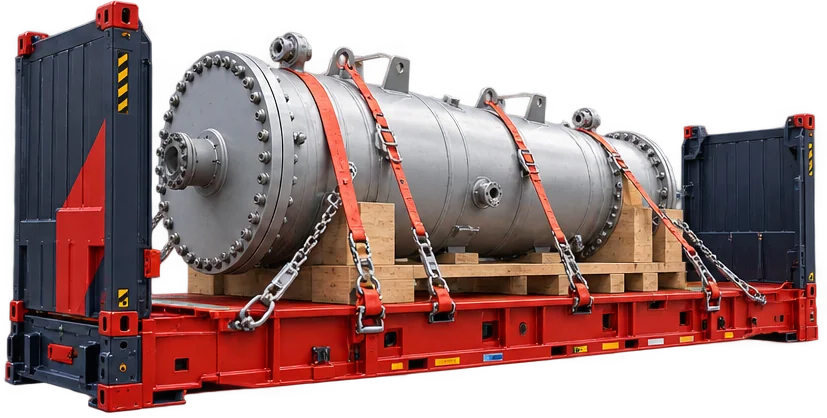
Start with the drawings and the site.
Review cargo drawings and weight, transport geometry, lifting/lashing concepts, route and schedule feasibility.
The technical brief
- Dimensions and mass
- Overall length, width and height of each piece, packed and unpacked, and its mass.
- Centre of gravity
- Its position as shown on the drawing, not estimated from the outside.
- Lifting and lashing points
- The points the manufacturer designed for lifting and securing, with their rated loads.
- Access at both ends
- Gates, ground bearing, overhead limits and the equipment available at the site.
- Method review
- Who reviews the method and signs it off before the movement is committed.
We do not publish lifting instructions or engineering calculations. A method is proposed after the drawings are reviewed, and it is approved by a qualified engineer before it is used.
What we need to assess a movement
- Drawings with the weight, centre of gravity and lifting points
- Overall length, width and height, packed and unpacked
- The route constraints you already know of (bridges, roads, port or airport limits)
- Site access and lifting equipment at origin and at destination
- The schedule, and the earliest and latest dates the movement can happen
Scope
Feasibility evaluation for out-of-gauge, heavy-lift, breakbulk and multimodal movements, subject to drawings, survey and partner validation.
Discuss the requirementsTell us the route and the cargo.
Industrial equipment and non-standard cargo requiring technical coordination.
Request a Quote